 United States
 Who is Franklin Delano Roosevelt?
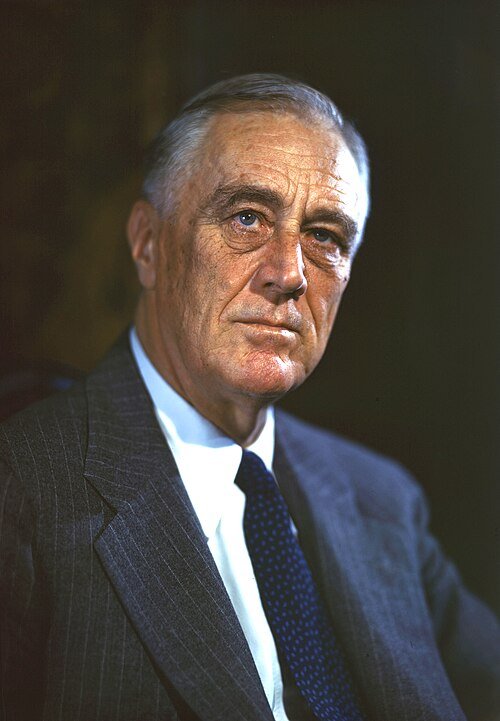
Franklin Delano Roosevelt (January 30, 1882 – April 12, 1945), often referred to by his initials FDR or President Roosevelt, was a towering figure in American history. His presidency spanned one of the most tumultuous periods in U.S. history, during which he guided the nation through economic turmoil and global conflict.
Roosevelt was born into the wealthy and influential Roosevelt family on January 30, 1882, in Hyde Park, New York. His father, James Roosevelt, a businessman and politician, ensured that Franklin received an elite education at Groton School, Harvard College, and Columbia Law School. Raised by his mother Sara Delano Roosevelt, who played a significant role in shaping his early years, young FDR was exposed to the social and political circles of New York.
Franklin’s rise to prominence began with his election as Assistant Secretary of the Navy under President Woodrow Wilson in 1913. His political career further accelerated when he became Governor of New York in 1928, a position that helped him gain national recognition and set the stage for his first presidential run.
Elected to the presidency in 1932, Roosevelt immediately faced the Great Depression, implementing a series of economic policies known as the New Deal to provide relief, recovery, and reform. He was re-elected an unprecedented four times, serving from 1933 until his death in 1945. During World War II, Roosevelt played a crucial role in forming international alliances and shaping post-war peace efforts.
His personal life was marked by significant challenges, including the loss of his ability to walk due to polio in 1921, which he kept largely private. Married to Eleanor Roosevelt since 1905, they had six children together, though only five survived infancy. Their partnership was not without its complexities; Franklin and Eleanor maintained a public marriage while each pursued separate interests and political agendas.
Roosevelt’s legacy is multifaceted: his New Deal programs laid the groundwork for modern American social welfare systems, and his leadership during World War II contributed significantly to Allied victory. His death in Warm Springs, Georgia, on April 12, 1945, was mourned across the nation and around the world.
Common Questions
What were Franklin D. Roosevelt's major accomplishments?
Roosevelt's key achievements include implementing the New Deal during the Great Depression to provide relief, recovery, and reform; leading America through World War II; and establishing significant international alliances.
How did Franklin D. Roosevelt become president?
Elected in 1932 as a Democrat on the promise of addressing the economic crisis, FDR won by a landslide due to his New Deal policies that promised immediate help for those suffering from the Great Depression.
What was Franklin D. Roosevelt's relationship with Eleanor?
Franklin and Eleanor were married in 1905; their marriage was complex, marked by both professional collaboration and personal distance, especially after he began an affair that Eleanor eventually accepted as a permanent aspect of their lives.
When did Franklin D. Roosevelt die?
Roosevelt died on April 12, 1945, in Warm Springs, Georgia, from the effects of a cerebral hemorrhage (stroke).
What were some challenges Franklin D. Roosevelt faced during his presidency?
Some major challenges included leading the country through both economic depression and war; managing domestic politics while ensuring U.S. involvement abroad; and dealing with significant health issues after contracting polio in 1921.