 United States
 Who is Richard Nixon?
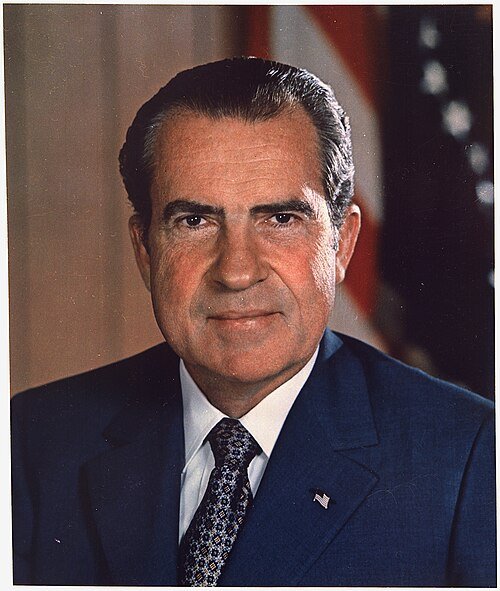
Richard Milhous Nixon (January 9, 1913 – April 22, 1994) remains one of the most intriguing figures in American history. His life is a testament to both political triumph and scandal, serving as the 37th president from 1969 until his resignation in 1974 amid the Watergate scandal.
Born in Yorba Linda, California, Nixon grew up in a modest Quaker family. His father Francis ran grocery stores, while his mother Hannah encouraged her sons to excel academically and morally. Nixon’s upbringing instilled in him a sense of duty and discipline that would later define his political career.
After graduating from Whittier College and Duke University Law School, Nixon embarked on a legal career before entering politics. He served as a member of the House of Representatives from 1947 to 1950 and then joined the Senate in 1950. His political ascent culminated with his election as Vice President under Dwight D. Eisenhower in 1952, a position he held until 1961.
In 1968, Nixon won the presidency over incumbent Lyndon B. Johnson’s vice president Hubert Humphrey, marking the first time since 1932 that an opposition candidate had won the White House while also taking control of both houses of Congress. His administration focused on foreign policy initiatives such as ending U.S. involvement in Vietnam and establishing relations with China. Domestic policies included economic reforms like wage-price controls.
Richard Nixon’s personal life was marked by a strong marriage to Patricia ‘Pat’ Ryan, whom he married in 1940. Together they had two daughters, Tricia and Julie, both of whom were raised in the public eye during their father’s political career. Despite his professional success, Nixon faced significant personal challenges, including the strain of political opposition and scandal.
The Watergate scandal led to Nixon’s resignation on August 9, 1974, making him the only U.S. president to have done so. In retirement, he wrote extensively about his experiences, earning a Grammy nomination for Best Spoken Word Album in 1992 with his audiobook version of In the Arena. He died on April 22, 1994, after suffering a stroke at his home in New York City.
Nixon’s legacy is complex and divisive. While some view him as a skilled diplomat who improved relations between the U.S., China, and the Soviet Union, others see him primarily through the lens of Watergate and its ramifications on American politics. His impact on foreign policy remains significant, but his domestic policies are often overshadowed by the scandal that ended his presidency.
Common Questions
What was Richard Nixon's early education?
Richard Nixon attended Whittier College from 1928 to 1934 and then Duke University Law School, graduating in 1937.
How did Richard Nixon become president?
Nixon won the presidency in the 1968 election over Hubert Humphrey after a successful political career that included service as vice president under Eisenhower from 1953 to 1961.
What were some of Richard Nixon's notable foreign policy achievements?
Nixon improved relations with China and the Soviet Union, signed the Anti-Ballistic Missile Treaty in 1972, and initiated the Strategic Arms Limitation Talks (SALT).
When did Richard Nixon resign as president?
Richard Nixon resigned from office on August 9, 1974, due to the Watergate scandal.
Did Richard Nixon have any children?
Yes, Richard and Patricia 'Pat' Nixon had two daughters: Tricia (born in 1946) and Julie (born in 1948).