 Russia
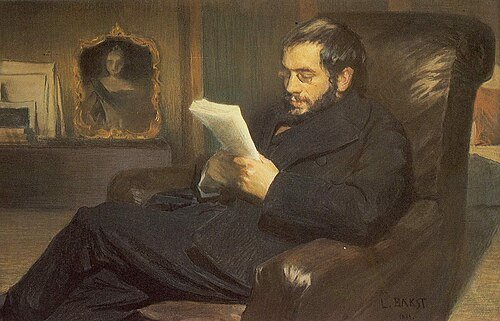
 Who is Alexandre Benois?
Alexandre Nikolaevich Benois, a towering figure in Russian art and culture, was born on April 21, 1870. His life spanned from the late imperial era through the tumultuous years of Soviet rule, making him an eyewitness to profound historical shifts that shaped his work.
Benois’s family background was rich with artistic heritage; his father, Nicholas Benois, was a respected architect and urban planner in Saint Petersburg. The young Alexandre grew up amidst cultural ferment, frequenting salons and exhibitions where he encountered figures like Leo Tolstoy and Ilya Repin. His formative years were spent at the prestigious Imperial St. Petersburg University.
His career ascended rapidly after his graduation, with Benois quickly establishing himself as a leading figure in Russian art circles through his work as both an artist and critic. He co-founded the World of Art magazine in 1899, which played a pivotal role in promoting modernist ideas within Russia.
In addition to his editorial contributions, Benois was prolific as a painter, designing numerous stage sets for the Ballets Russes and contributing to architectural projects that included the Winter Palace’s restoration after the Russian Revolution. His work often reflected themes of national identity and cultural revival, earning him international acclaim.
Benois’s personal life was equally rich with artistic collaborations and familial ties. He married Anna Karlovna Benois in 1897, a union that produced two children: Nicola and Hélène Clément-Benois. His brother Leon, also an artist, was part of the same cultural milieu.
His legacy is profound. Alexandre Benois passed away on February 9, 1960, leaving behind a body of work that spans across painting, writing, and historical scholarship. He remains celebrated for his contributions to Russian culture and art history, having shaped the aesthetic landscape of early twentieth-century Russia through both creation and critique.
Common Questions
What was Alexandre Benois's birth name?
Alexandre Nikolaevich Benois was born on April 21, 1870.
Who were some of the key figures in Alexandre Benois's early life?
In his youth, Benois encountered notable cultural figures such as Leo Tolstoy and Ilya Repin, which influenced his artistic development.
What significant roles did Alexandre Benois play beyond being a painter?
He co-founded the World of Art magazine in 1899 and was also an influential stage designer for the Ballets Russes.
How did Alexandre Benois contribute to Russian architecture?
Benois designed sets and contributed architectural insights, including work on restoring the Winter Palace after the Russian Revolution.
Who were some of Alexandre Benois's family members in his professional circle?
His brother Leon Benois was also an artist, and they both were part of Saint Petersburg’s vibrant cultural milieu.