 United States
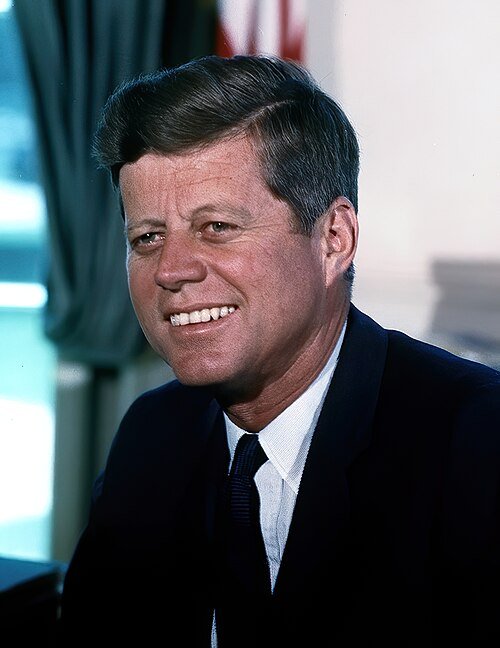
 Who is John F. Kennedy?
John Fitzgerald Kennedy, often referred to as Jack or J.F. Kennedy, was a pivotal figure in American politics and one of the most charismatic presidents in U.S. history. Born on May 29, 1917, in Brookline, Massachusetts, his life intersected with major historical events that shaped the world we live in today.
His family background rooted deeply in Irish-American heritage, Kennedy was born into a prominent political dynasty. His father, Joseph P. Kennedy Sr., held influential positions within the Democratic Party and served as Ambassador to the Court of St. James’s under President Franklin D. Roosevelt. Growing up with seven siblings, including future Senator Edward M. “Ted” Kennedy, John F. Kennedy developed a strong sense of public service from an early age.
After graduating from Harvard College in 1940, where he wrote his thesis on the aftermath of British appeasement policies toward Nazi Germany, which was later published as A Nation of Immigrants, Kennedy enlisted in the U.S. Navy during World War II. He earned national recognition for his heroic actions while serving aboard PT-109 and was honorably discharged in 1945.
Upon returning to civilian life, Kennedy entered politics as a member of Congress representing Massachusetts’s 11th district from January 3, 1947, to January 3, 1953. He then served as a U.S. Senator for Massachusetts from January 3, 1953, until January 2, 1961. Kennedy’s political career was marked by his eloquent speeches and progressive policies, which resonated with the American public during the Cold War era.
In 1960, he successfully campaigned for the presidency under the banner of the Democratic Party, defeating Republican candidate Richard Nixon in a close race that saw Kennedy win popular support by a narrow margin. As president, Kennedy focused on civil rights legislation, space exploration (including the commitment to land an American on the moon), and the containment of communist influence abroad, notably through his leadership during the Cuban Missile Crisis.
His personal life was equally notable. In 1953, he married Jacqueline Bouvier, a journalist who became known for her grace and elegance as First Lady. The couple had four children: Arabella (who died shortly after birth), Caroline Kennedy Schlossberg, John F. Kennedy Jr., and Patrick Bouvier Kennedy.
Tragically, his presidency was cut short when he was assassinated by Lee Harvey Oswald on November 22, 1963, in Dallas, Texas. His death left an indelible mark on American history and cemented his legacy as a visionary leader whose policies and rhetoric inspired a generation.
Common Questions
What were some of Kennedy's major achievements?
Kennedy's significant accomplishments include the establishment of the Peace Corps, initiating civil rights legislation, supporting space exploration with programs like NASA's Apollo missions, and his handling of the Cuban Missile Crisis.
How did John F. Kennedy start his political career?
After serving in World War II, Kennedy was elected to represent Massachusetts' 11th district as a U.S. Representative on January 3, 1947, and later became a U.S. Senator representing the state of Massachusetts from January 3, 1953.
Who were John F. Kennedy's siblings?
Kennedy was part of a large family that included his brother Robert F. Kennedy (who served as Attorney General), and sister Eunice Kennedy Shriver (co-founder of Special Olympics). His other siblings were Joseph P. Kennedy Jr., Rosemary Kennedy, Kathleen Cavendish, Patricia Kennedy Lawford, Jean Kennedy Smith, and Ted Kennedy.
What was the Cuban Missile Crisis?
The Cuban Missile Crisis occurred in October 1962 when Kennedy confronted Soviet Premier Nikita Khrushchev over missiles installed by the Soviets in Cuba. Through diplomatic negotiations, he successfully averted nuclear war and secured an agreement to remove the weapons.
What was John F. Kennedy's educational background?
Kennedy attended Harvard College (now Harvard University), graduating cum laude with a degree in international relations in 1940. He also spent time at Choate Rosemary Hall and later enrolled briefly at Princeton University and Stanford Graduate School of Business.
When did John F. Kennedy become president?
John F. Kennedy was inaugurated as the 35th President of the United States on January 20, 1961, succeeding Dwight D. Eisenhower after a closely contested election against Richard Nixon in November 1960.
What were some of Kennedy's notable speeches?
Kennedy delivered several memorable speeches, including his inaugural address where he famously said 'ask not what your country can do for you—ask what you can do for your country,' and his civil rights speech at the Lincoln Memorial in June 1963.
How did Kennedy's assassination impact America?
Kennedy's assassination had profound effects on American society, leading to increased calls for gun control legislation and inspiring numerous conspiracy theories. It also marked a turning point in the Cold War era and influenced future presidential security measures.
Who was Jacqueline Kennedy Onassis?
Jacqueline Bouvier Kennedy became First Lady of the United States upon her marriage to John F. Kennedy in 1953. Known for her poise and style, she played a significant role as an advocate for arts and culture during JFK's presidency.
What were some of Kennedy's hobbies?
Kennedy enjoyed reading, sailing, writing, and golfing. He was also known to be an avid reader and writer, authoring books such as A Nation of Immigrants before his presidency.