 United States
 Who is Jean Sibelius?
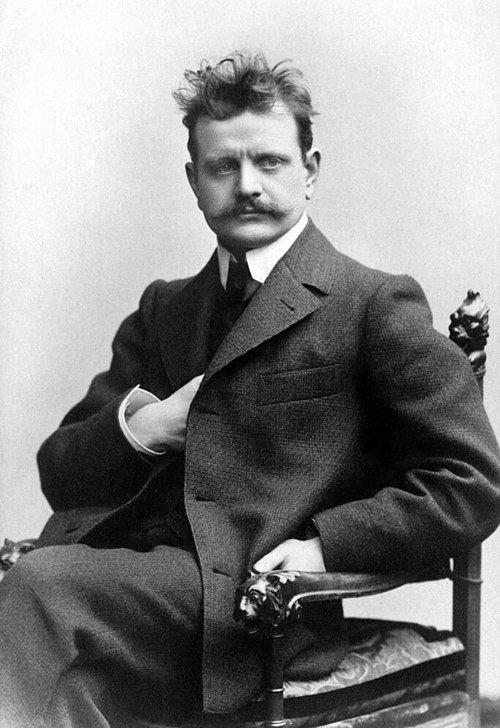
John Julius Christian Sibelius, better known as Jean Sibelius (December 8, 1865 – September 20, 1957), was a Finnish composer who became one of the most important figures in classical music. Born into a family where education and culture were valued, his early life in Hämeenlinna, Finland, was marked by exposure to both Swedish and Finnish languages, as well as musical influences from local folk traditions.
Sibelius’s journey to prominence began with his studies at the University of Helsinki, where he focused on law before switching his major to music. After graduating, Sibelius moved to Berlin and Vienna for further training in composition, which would prove pivotal in shaping his unique style. His breakthrough came with En saga, a tone poem that premiered in 1893, followed by the highly patriotic symphonic poem Karelia. These works quickly established Sibelius as Finland’s leading composer.
Sibelius’s career flourished over decades marked by major compositional milestones. His Symphony No. 2 in D minor was completed in 1902, and the monumental Symphony No. 5 premiered in 1915. Despite a period of relative silence after his Seventh Symphony in 1924, Sibelius continued to influence future generations through his teaching at the Helsinki Music Institute from 1896 to 1911.
On the personal front, Jean Sibelius married Aino Järnefelt on June 15, 1892. The couple had six children, with three surviving into adulthood: Ruth Snellman, Heidi Blomstedt, and Katarina Ilves. His marriage to Aino was a constant throughout his life, providing both support and inspiration for his work.
Sibelius’s legacy is profound, extending far beyond Finland to the global stage of classical music. He died in Järvenpää on September 20, 1957, due to complications from an intracranial hemorrhage, leaving behind a body of work that continues to be celebrated for its nationalistic themes and innovative orchestral techniques.
Common Questions
Where was Jean Sibelius born?
Jean Sibelius was born in Hämeenlinna, Finland on December 8, 1865.
What are some of Jean Sibelius's most famous works?
Some of his most famous works include En saga, Symphony No. 2 in D minor, and Symphony No. 5.
Did Jean Sibelius have any siblings?
Jean Sibelius had a brother named Christian Sibelius.
How did Jean Sibelius die?
Jean Sibelius died on September 20, 1957 in Järvenpää due to complications from an intracranial hemorrhage.
What was the significance of Sibelius's Symphony No. 5?
Symphony No. 5 premiered in 1915 and is considered one of his most important works, known for its innovative orchestration and nationalistic themes.
How long did Jean Sibelius teach at the Helsinki Music Institute?
Jean Sibelius taught at the Helsinki Music Institute from 1896 to 1911.