 United States
 Who is Richard Feynman?
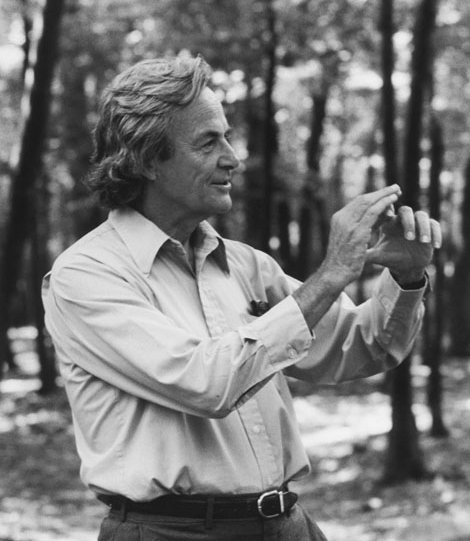
Richard Phillips Feynman, an American physicist renowned for his groundbreaking work on quantum mechanics and particle theory, was born on May 11, 1918, in New York City and passed away on February 15, 1988. His life spanned just under seven decades but left an indelible mark on the scientific community.
Feynman grew up in Far Rockaway, Queens, with his parents, Melville Arthur Feynman and Lucille Phillips. A prodigy from a young age, he was captivated by mathematics and physics, often engaging with complex theories far beyond his years. He credits his sister Joan for introducing him to scientific ideas at an early stage.
After excelling in his studies at the Massachusetts Institute of Technology (MIT), Feynman went on to earn his Ph.D. from Princeton University under John Archibald Wheeler’s supervision in 1942. His career took off during World War II when he joined the Manhattan Project, contributing significantly to the development of the atomic bomb.
Post-war, Feynman became a professor at Cornell University and later moved to Caltech (California Institute of Technology), where his innovative approach to teaching physics earned him widespread acclaim. His work on quantum electrodynamics led to his Nobel Prize in Physics in 1965 for the development of diagrammatic techniques that simplify calculations involving subatomic particles.
On a personal note, Feynman married Arline Richards in 1941; she died from tuberculosis shortly after their marriage. He later remarried and had a daughter named Michelle. Throughout his life, he maintained an unorthodox lifestyle with a passion for playing the bongo drums, cracking safes at Los Alamos, and engaging in various other pursuits that showcased his unconventional brilliance.
Richard Feynman’s legacy is one of profound scientific insight combined with an infectious enthusiasm for learning. His famous lectures on physics have been published as books and continue to inspire new generations of scientists. He passed away from abdominal cancer at the age of 69, leaving behind a remarkable body of work that continues to influence theoretical physics.
Common Questions
What did Richard Feynman contribute to the Manhattan Project?
During World War II, Feynman worked on the Manhattan Project at Los Alamos National Laboratory. His contributions included solving complex mathematical problems and devising methods for purifying plutonium.
When did Richard Feynman win the Nobel Prize in Physics?
Feynman was awarded the Nobel Prize in Physics in 1965, sharing it with Julian Schwinger and Sin-Itiro Tomonaga for their fundamental work in quantum electrodynamics.
What are some of Richard Feynman's most famous books?
Some of his most well-known books include 'The Feynman Lectures on Physics,' 'Surely You're Joking, Mr. Feynman!,' and 'Six Easy Pieces.'
How did Richard Feynman die?
Richard Feynman died on February 15, 1988, in Los Angeles, California, due to abdominal cancer.
What was Richard Feynman's first wife's name and what happened to her?
Feynman married Arline Richards in 1941. She died from tuberculosis shortly after their marriage.