-
01
MacArthur graduated from the United States Military Academy at West Point on June 11, 1903, and later returned as its superintendent from 1919 to 1922 before resuming his military career.
-
02
He accepted the surrender of the Japanese aboard the USS Missouri on September 2, 1945, and directed the occupation of Japan from 1945 to 1950, instituting reforms such as female suffrage, freedom of the press, workers’ unionization rights, and land ownership for peasants.
-
03
MacArthur and his father, Arthur MacArthur, are the first father and son to be awarded the Medal of Honor. MacArthur received his for World War II service; his father earned it as a private in the Battle of Missionary Ridge during the Civil War. Theodore Roosevelt and his son were later similarly honored in 2001.
-
04
He was awarded the Congressional Gold Medal in 1962.
-
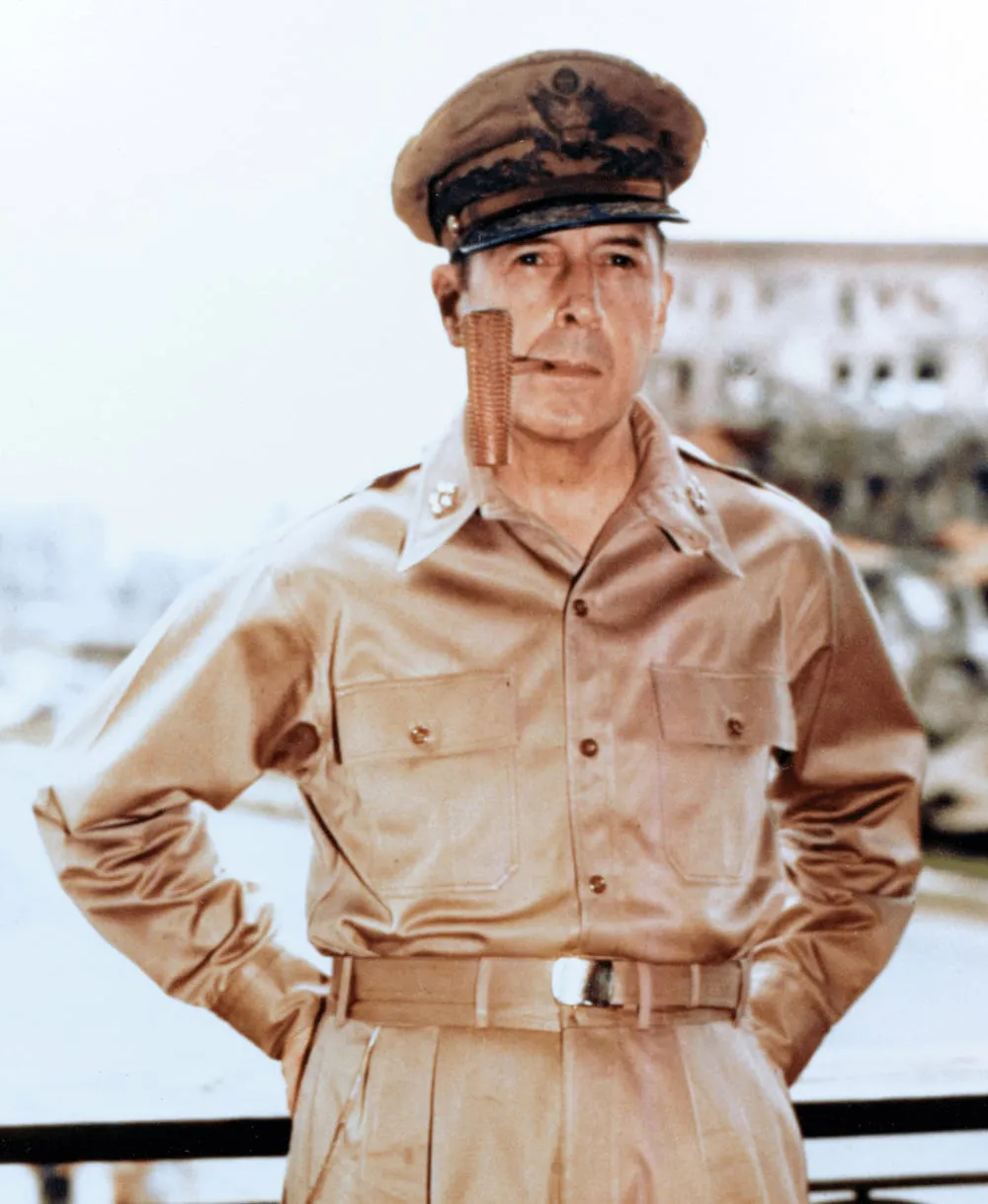
05
A movie buff, MacArthur was known to attend movies with his wife Jean most evenings during his pre-war tenure as military commander of the Philippines.
-
06
Truman’s removal of MacArthur caused the former’s popularity to plummet and contributed to his decision not to seek re-election; Truman still has one of the lowest approval ratings ever recorded for a sitting president.
-
07
MacArthur retired with the rank General of the Army five stars.
-
08
He was pictured on a 6-cent U.S. commemorative postage stamp issued on January 26, 1971, the 91st anniversary of his birth.
-
09
MacArthur was awarded the Congressional Medal of Honor during World War II as a general.
-
10
He was relieved as Supreme Allied Commander by President Harry S. Truman in April 1951 during the Korean War. Fearing nuclear war with the USSR, Truman warned MacArthur against incursion into China, but MacArthur publicly criticized that policy. Truman interpreted this as a challenge to civilian control and relieved him. MacArthur returned to massive adulation, epitomized by his Old soldiers never die address to Congress, interrupted by 30 ovations.
-
11
MacArthur is the only American officer to hold the rank of Field Marshal, as commander of the Philippine armed forces.
-
12
He and his wife Jean had a son, Arthur MacArthur.
-
13
Famous for smoking a corncob pipe and being very outspoken in the same manner as George S. Patton.
-
14
He was a Grand Cross Knight in the Order of Orange Nassau, the highest honor a foreigner can receive from the Netherlands.
-
15
MacArthur is buried at the MacArthur Memorial in Norfolk, Virginia.
-
16
He promoted himself aggressively for a Medal of Honor, even recommending himself after one mission. Many felt his Medal of Honor for Defense of the Philippines was undeserved because the Philippines fell to Japan and he did not personally engage in combat, instead being evacuated. Eisenhower himself blocked his own Medal of Honor because he had not been under fire. MacArthur acknowledged the controversy by stating he accepted it only in recognition of the men under his command. He admitted early in his career that he was willing to sell his soul for the Medal of Honor.
-
17
Around late 1930, MacArthur began referring to himself exclusively by his last name, even conversationally.
-
18
Contrary to popular belief, MacArthur never recommended the use of atomic weapons during the Korean War, though he did suggest using radioactive poisons to cut off North Korea if the Soviet Union formally entered. In a posthumous interview, he was quoted as saying he did want to use atomic weapons.
-
19
Australia’s General Thomas Blamey, a senior field commander under MacArthur, said before his death that the best things you would hear about MacArthur are true whilst the worst are indeed true, referencing MacArthur’s disdainful treatment of Australian troops.
-
20
MacArthur rarely approached the front lines, leading him to believe his men were slacking when they were held up by terrain. On at least two occasions, commanders were sacked just before success, and their replacements received the credit.
-
21
Though a registered Republican who clashed with FDR over defense budgets, MacArthur supported the New Deal, especially the Civilian Conservation Corps. He considered running for president in 1932, after crushing the Bonus Army marchers, and again in 1944, when credited with Allied victories in New Guinea and the Philippines.
-
22
MacArthur turned down the promotion of Joseph Lawton Collins to corps general, saying Joe being only 45 is too young for a corps command. Collins later served as Army Chief of Staff during the Korean War and contributed to MacArthur’s relief.
-
23
General Robert Eichelberger, commander of the U.S. 8th Army in the Pacific, was told that MacArthur would think of nominating him for a Congressional Medal of Honor. Eichelberger called it the best possible compliment General MacArthur would give to literally anybody.
-
24
Among nine five-star officers, MacArthur is frequently considered the worst promotee due to misguided strategic insights, refusal to maintain a coalition combat structure, and prioritizing personal goals over Allied objectives.
-
25
After MacArthur’s death in 1964, supporters in Congress moved to promote him to the six-star rank of General of the Armies, but the motion was denied. One senator called him our greatest soldier, but a senior general sarcastically retorted, our greatest actor.
-
26
MacArthur appeared on the cover of Time Magazine five times: in 1935, 1941, 1944, 1945, and 1949.
-
27
Though George Patton is often considered the wealthiest U.S. officer during their careers, MacArthur was believed to be the richest senior commander at his death in 1964, thanks to inheriting his father’s estate, a $15,000 annual pension, board salaries, and a controversial $750,000 payment from Philippine President Manuel Quezon before they fled to Australia in 1942.
-
28
His reputation for insubordination reached such heights that when President Lyndon Johnson appointed General William Westmoreland to command forces in Vietnam, he told him, ‘I have a lot riding on you General but please don’t pull out a MacArthur on me.
-
29
A classic ‘mama’s boy, MacArthur paid muckraking columnist Drew Pearson $15,000 to return letters from an affair while living with his wife and mother in the Philippines.
-
30
MacArthur was the former stepfather of Tanya Brooks.
-
31
Barring the Inchon landing, widely considered his greatest accomplishment, MacArthur conducted most of his Korean campaign from safety in Japan.
-
32
After refusing an integrated allied command structure in Australia and insisting Americans never report to Australian superiors, one officer sarcastically said, ‘MacArthur doesn’t have a staff, he has an imperial court.
-
33
MacArthur topped his batch of 1903 at the United States Military Academy.
-
34
He was head of the U.S. Committee for the 1928 Summer Olympics.
-
35
Critics maintained his leapfrogging strategy caused heavy American casualties during the Pacific Campaign.
-
36
MacArthur intensely disliked Admiral Chester Nimitz, commander of the Pacific Fleet, and the feeling was mutual. Their disagreements are among the most intense clashes between theatre-level commanders in modern history.
-
37
President Harry Truman, who relieved MacArthur, was from Independence, Missouri. Coincidentally, MacArthur accepted the Japanese surrender aboard the USS Missouri.
-
38
Though MacArthur called Eisenhower the best desk clerk I ever had, MacArthur himself had never commanded field forces except for a minor skirmish in the Poncho Villa Expedition and a short brigade command in World War I.
-
39
Eisenhower served as MacArthur’s chief of staff in the Philippines and was disdainful of his conduct. When asked about MacArthur’s talents, Eisenhower sarcastically said he studied dramatics for five years in the Philippines under General MacArthur. Later, Eisenhower used Truman’s dismissal of MacArthur to attack the Democratic Party as weak on communism.