 United States
 Who is Lyndon B. Johnson?
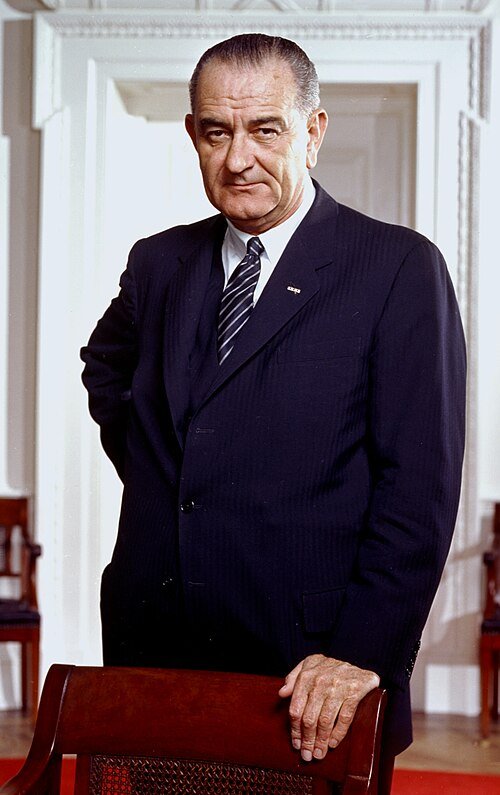
Lyndon Baines Johnson, often referred to as LBJ or simply Johnson, was a towering figure in American politics whose influence extended well beyond his tenure as the 36th President of the United States from 1963 to 1969. His life, spanning from August 27, 1908, until January 22, 1973, was marked by ambitious political maneuvers and a complex legacy that continues to shape discussions about American democracy.
Born in the small town of Stonewall, Texas, Johnson’s early life was rooted deeply in the rural South. His father, Samuel Ealy Johnson Jr., and mother, Rebekah Baines, instilled in him a strong sense of community and political awareness. This upbringing set the stage for his future career as he sought to rise through the ranks of the Democratic Party.
Johnson’s ascent to power was marked by significant milestones that solidified his status as one of the most influential politicians of the 20th century. He served in the U.S. House of Representatives from 1937 to 1949, representing Texas’s 10th district and gaining experience in federal politics. His time as Senate Majority Leader from 1955 to 1961 was particularly transformative; he played a crucial role in passing civil rights legislation against considerable opposition.
In the wake of President Kennedy’s assassination on November 22, 1963, Johnson assumed the presidency and quickly made his mark with the passage of landmark legislation. His administration saw the enactment of the Civil Rights Act of 1964 and the Voting Rights Act of 1965, both of which were pivotal in advancing racial equality.
Johnson’s personal life was closely tied to his political career. He married Claudia Alta Taylor (Lady Bird Johnson) on November 17, 1934, a union that lasted until his death and provided him with strong support through years of public service. The couple had two daughters: Lynda Bird Johnson Robb and Luci Baines Johnson.
Despite his legislative triumphs, Johnson’s legacy is also marked by the escalation of U.S. involvement in Vietnam, which proved to be a significant source of domestic unrest and international tension. After leaving office in 1969, he returned to Texas where he devoted himself to philanthropic efforts and the study of public policy.
Johnson passed away on January 22, 1973, due to myocardial infarction at his ranch in Stonewall, Texas. His contributions to civil rights and domestic policies have left an enduring impact on American society, making him a figure of both admiration and controversy within the context of U.S. history.
Common Questions
Where was Lyndon B. Johnson born?
Lyndon B. Johnson was born in Stonewall, Texas.
What were some key achievements of LBJ's presidency?
Key achievements include the Civil Rights Act of 1964 and the Voting Rights Act of 1965.
Did Lyndon B. Johnson receive any awards or nominations during his career?
Johnson was nominated for the Nobel Peace Prize in 1964 for his efforts to prevent nuclear war, though he did not win it.
How many children did Lyndon and Lady Bird Johnson have?
The couple had two daughters: Lynda Bird Johnson Robb and Luci Baines Johnson.
What was Lyndon B. Johnson's educational background?
Johnson attended Texas State University and later pursued law at Georgetown University Law Center, though he did not complete his degree there.