 Austria
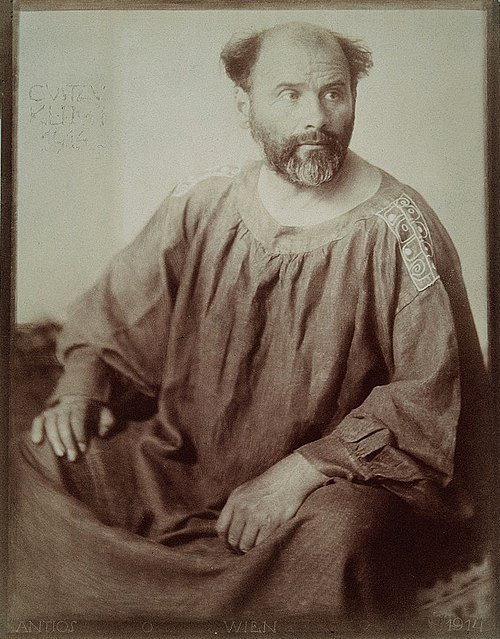
 Who is Gustav Klimt?
Gustav Klimt, born on July 14, 1862, and passing away on February 6, 1918, was a pivotal figure in the Art Nouveau movement. His paintings, such as The Kiss, are celebrated for their intricate gold leaf decoration and bold, sensual themes.
Klimt grew up in a modest family in Baumgarten, Austria. His father, Ernst Klimt, worked variously as an engraver and stonemason, while his mother, Anna Klimt, was a cook. Gustav’s early experiences with art were nurtured by his brothers, Ernst and Georg, who shared a passion for drawing.
In 1876, at the age of fourteen, Klimt enrolled in Vienna’s School of Arts and Crafts (now University of Applied Arts Vienna), where he excelled. He soon founded a studio with two fellow students, leading to his first significant public commission for the Burgtheater’s ceiling frescoes in 1887.
Throughout the late nineteenth century and early twentieth century, Klimt’s work evolved from the traditional academic style into a more modern one that incorporated symbolism and eroticism. His famous The Kiss, completed around 1907-1908, epitomized his mature style, characterized by elaborate ornamentation and bold, flat forms.
His personal life was marked by several significant relationships, including Emilie Louise Flöge, with whom he lived for many years. Although Klimt never married, he had a daughter named Gustav Ucicky from an affair in 1897. Despite his notoriety and success, Klimt maintained a private life that often kept him at odds with the conservative Viennese establishment.
Tragically, Klimt passed away on February 6, 1918, due to a stroke, leaving behind an indelible legacy of provocative and innovative art. Today, he is recognized as one of the most influential artists of his time, with works that continue to captivate audiences around the world.
Common Questions
What was Gustav Klimt's education?
Klimt studied at the School of Arts and Crafts in Vienna from 1876 until he graduated in 1883.
Who were some of Gustav Klimt’s significant works?
Some of his most famous works include The Kiss (around 1907-1908) and the ceiling frescoes for the Kunsthistorisches Museum Vienna (1892-1894).
Did Gustav Klimt marry?
No, Gustav Klimt never married but had several significant relationships, notably with Emilie Louise Flöge.
What was the cause of Gustav Klimt's death?
Gustav Klimt died on February 6, 1918, from a stroke at the age of 55.
How did Gustav Klimt influence the Art Nouveau movement?
Klimt’s work was instrumental in pushing the boundaries of traditional academic art towards more modern and symbolic representations. His use of gold leaf and intricate designs set new standards for decorative painting.