 Germany
 Who is Hermann Göring?
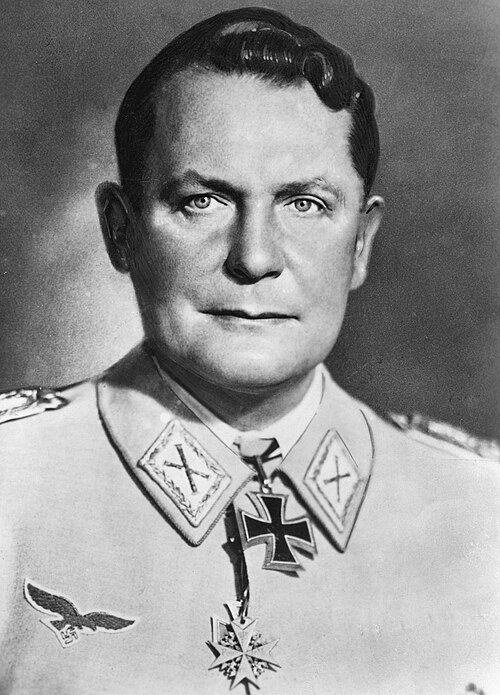
Hermann Wilhelm Göring was one of the most influential figures in Nazi Germany, known for his roles as Reichsmarschall, Commander-in-Chief of the German Air Force (Luftwaffe), and a leading member of Adolf Hitler’s inner circle. His life spanned from January 12, 1893, to October 15, 1946.
Göring was born in Rosenheim, Bavaria, Germany, to Heinrich Ernst Göring, an official in the colonial service of the German Empire, and Franziska Tiefenbrunn. The family lived briefly in Namibia before returning to Germany, where young Hermann received a military education at the cadet school in Karlsruhe. His father’s connections ensured that he was admitted to the prestigious German Army officer corps.
Göring’s rise to prominence began when he joined the fledgling Nazi Party and became one of its earliest members. He served with distinction as an ace fighter pilot during World War I, earning multiple medals for bravery. His military prowess and political acumen saw him become a close ally of Hitler, who appointed him Reichsmarschall, second only to himself in rank.
Göring’s career was marked by several significant achievements: he reorganized the German air force after 1933, expanded it into one of the most powerful military branches in Europe, and oversaw the Luftwaffe during major conflicts such as the invasion of Poland and the Battle of Britain. He also chaired the notorious Reichstag Fire Inquiry Committee and established the Gestapo.
On the personal front, Göring married his first wife, Carin von Kantzow, a nurse and writer, who died in 1931 after battling tuberculosis for years. He then remarried Emmy Sonnemann in 1935. Their daughter Edda was born that year.
After World War II ended, Göring was captured by American forces and tried at the Nuremberg Trials. Found guilty of war crimes, he requested to be executed with cyanide rather than facing the gallows, which led to his suicide on October 15, 1946.
Hermann Göring’s legacy remains a contentious topic; while some regard him as a brilliant military strategist and political leader, others see him as one of history’s most notorious villains due to his role in Nazi atrocities.
Common Questions
What was Hermann Göring's rank?
Göring held the highest rank possible within the Third Reich, that of Reichsmarschall. He was second only to Adolf Hitler in the Nazi hierarchy.
When did Hermann Göring join the Nazi Party?
Hermann Göring joined the Nazi Party in 1923 and became one of its earliest members.
Who were some key figures in Hermann Göring's life?
Key figures included Adolf Hitler, who was a close political ally; Carin von Kantzow, his first wife; and Emmy Sonnemann, his second wife. His brother Albert Göring also played an interesting role, opposing the Nazi regime.
How did Hermann Göring die?
Göring chose to end his life by suicide with cyanide before he could be executed at the Nuremberg Trials on October 15, 1946.
What were some of Hermann Göring's military roles?
He served as an ace fighter pilot during World War I and later became Commander-in-Chief of the German Air Force (Luftwaffe) after Hitler came to power in 1933.