 Germany
 Who is Wernher Von Braun?
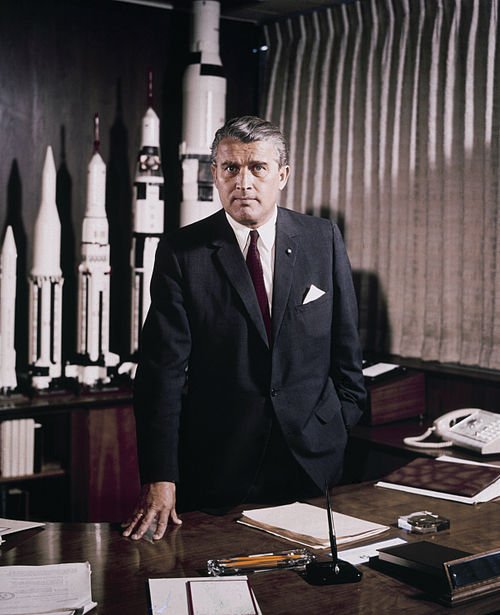
Wernher Magnus Maximilian Freiherr Von Braun, born on March 23, 1912, in Wessenberg, Germany, was a towering figure in the history of space exploration. His legacy is marked by his profound contributions to rocket technology that bridged the gap between Nazi Germany’s V-2 program and NASA’s Apollo moon missions.
Von Braun came from an aristocratic family; his father Magnus Von Braun held high-ranking positions in the German colonial service, while his mother Emmy Von Braun was a descendant of Martin Luther. Young Wernher found solace and inspiration in rocketry from an early age, building models and reading science fiction literature that fueled his ambition to explore space.
His academic journey began at the Technische Universität Berlin where he studied physics and mathematics. Here, he also joined Hermann Oberth’s Society for Space Travel, a group of enthusiasts who shared his passion for rocketry. By 1932, Von Braun had completed his doctorate in physics from the Friedrich-Wilhelms-Universität zu Berlin (now Humboldt University).
During World War II, Von Braun became involved with Germany’s secret weapons program and developed the V-2 ballistic missile for the Nazi regime. After the war, he was brought to the United States as part of Operation Paperclip to aid in America’s burgeoning space exploration efforts.
Von Braun’s career flourished under NASA where he played a crucial role in developing the Saturn V rocket that powered the Apollo missions to the moon. His vision for human spaceflight and his leadership in the development of reusable spacecraft laid the groundwork for future generations of space scientists and engineers.
Outside of work, Von Braun married Maria von Quistorp on June 1, 1947, and they had three children together: Iris Careen, Peter Konstantin, and Magrit. His personal life was marked by a deep sense of family commitment alongside his relentless pursuit of scientific advancement.
Wernher von Braun passed away on June 16, 1977, in Alexandria, Virginia, due to pancreatic cancer at the age of 65. Despite controversies surrounding his work for Nazi Germany, Von Braun’s contributions to space exploration are celebrated worldwide as monumental milestones that shaped humanity’s journey into the cosmos.
Common Questions
What were Wernher von Braun's early educational pursuits?
Von Braun studied physics and mathematics at Technische Universität Berlin. He later completed his doctorate in physics from Friedrich-Wilhelms-Universität zu Berlin.
How did World War II influence Von Braun's career?
During WWII, Von Braun was involved with Germany’s secret weapons program where he developed the V-2 ballistic missile for the Nazi regime. This work would later earn him recognition in America as a key figure in space exploration after being brought to the US under Operation Paperclip.
What were some of Wernher von Braun's major achievements?
Von Braun played a pivotal role in developing the Saturn V rocket that powered NASA’s Apollo missions, which included landing humans on the moon. His contributions also extended to early concepts for reusable spacecraft and space stations.
How many children did Wernher von Braun have?
Wernher von Braun had three children with his wife Maria von Quistorp: Iris Careen, Peter Konstantin, and Magrit.
What was Wernher von Braun's impact on the field of space exploration?
Von Braun’s work laid the foundation for future generations of space scientists. His leadership in developing the Saturn V rocket and his vision for human spaceflight were instrumental in advancing humanity's journey into outer space.