 United States
 Who is Ronald Reagan?
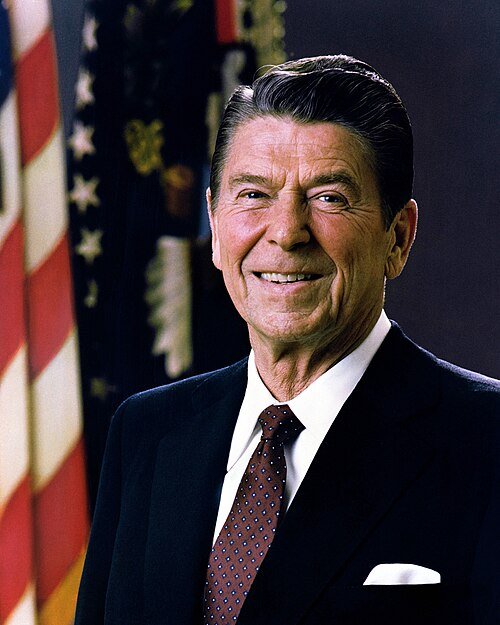
Ronald Wilson Reagan, the fortieth President of the United States (1981-1989), was born on February 6, 1911, in Tampico, Illinois. A towering figure in American political and cultural history, he transformed from a Hollywood actor into one of America’s most charismatic leaders.
Reagan grew up as the second child in his family after Neil Reagan. His father Jack was an erratic alcoholic who struggled to provide stability, while his mother Nelle Wilson Reagan offered emotional support and nurtured Ronald’s love for literature and politics. Despite financial hardships, Reagan excelled academically and graduated from Eureka College with a degree in economics and sociology.
After college, Reagan embarked on a career as a radio announcer before transitioning to Hollywood. He starred in numerous films but also found success behind the scenes as a screenwriter and voice actor. His political awakening came during his time with General Electric, where he served as an executive and spokesman for the company’s traveling theater troupe.
Reagan’s rise to prominence began when he entered politics as a Democrat before switching to the Republican Party in 1962. He was elected Governor of California in 1967 and re-elected in 1970, bringing his conservative policies to the forefront of American political discourse. After leaving office in 1975, Reagan focused on national politics and secured the Republican nomination for president in 1980.
His marriage to actress Jane Wyman produced two children: Maureen and Michael, before they divorced in 1948. In 1952, he married Nancy Davis (later Nancy Reagan), with whom he had two more children: Patricia and Ronald Jr., who was born after a long period of infertility. Nancy played an essential role as First Lady, managing the White House and her husband’s political career.
During his presidency, Reagan advocated for tax cuts, deregulation, increased military spending, and anti-communism policies, including support for anticommunist movements abroad. His tenure saw a thaw in Cold War tensions with Soviet leader Mikhail Gorbachev. In 1981, he survived an assassination attempt and continued to lead the nation through economic recovery and foreign policy challenges.
Reagan passed away on June 5, 2004, at the age of 93 after suffering from Alzheimer’s disease for several years prior to his death. His legacy includes a significant shift in American political ideology, an enduring influence on Republican politics, and a presidency marked by both economic prosperity and military confrontation.
Common Questions
What was Ronald Reagan’s early career before entering politics?
Before becoming a politician, Reagan worked as an actor in Hollywood. He starred in over fifty films and also served as a radio announcer for the Chicago Cubs baseball team.
How did Ronald Reagan become president of the United States?
Reagan secured the Republican nomination for president in 1980 after serving two terms as Governor of California. He won the election against incumbent Jimmy Carter and took office on January 20, 1981.
How many children did Ronald Reagan have?
Ronald Reagan had five children: Maureen, Michael, Patricia (Patti), Ron Jr., and Christine, though only four were alive at the time of his presidency. He was married twice: first to Jane Wyman, then Nancy Davis.
What is Ronald Reagan's legacy?
Reagan’s legacy includes a significant shift towards conservative economic policies in America and an enduring influence on Republican politics. His administration also marked the end of the Cold War era through his engagement with Soviet leader Mikhail Gorbachev.
When did Ronald Reagan pass away?
Ronald Reagan died on June 5, 2004, at the age of 93, after battling Alzheimer's disease for a decade.