Early life
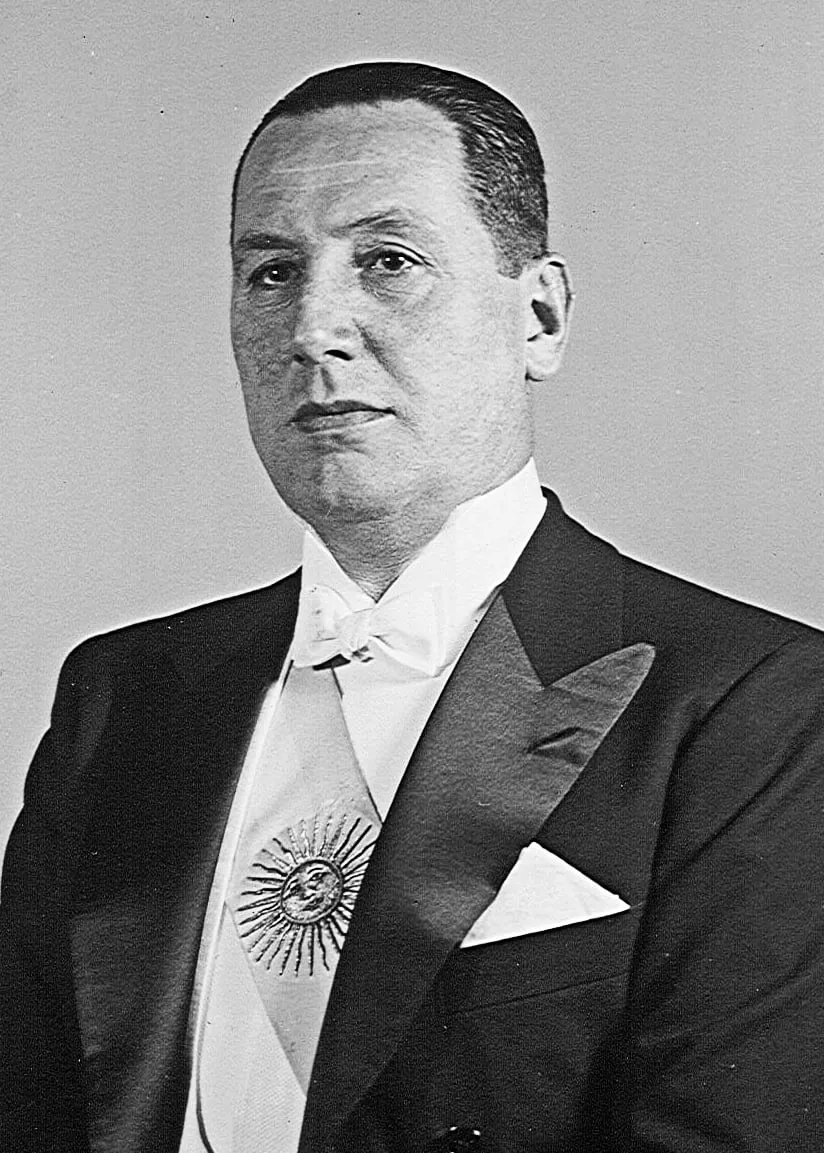
Juan Domingo Perón was born on October 8, 1895, in Lobos, Buenos Aires, Argentina, to Juana Sosa Toledo and Mario Tomás Perón. He attended the Nation Military College, began his military career, and rose to lieutenant general.
7 min read
Reading time
1,314
Words
Published
22
Awards
Juan Domingo Perón, a lieutenant general and politician, founded the Peronist movement and served three times as President of Argentina. He first took office in 1946 after creating the Labour Party, which later became the Justicialist Party. His first wife, Eva Perón, was a political figure until her death in 1952. Perón died of cardiac arrest in 1974 at age 78.
Names, aliases, and relatives of Juan Domingo Perón — birth name, kin, and personal ties.
Juan Domingo Perón by the numbers — life, work, and family.
Juan Domingo Perón — early life, career, personal life, and legacy.
Juan Domingo Perón was born on October 8, 1895, in Lobos, Buenos Aires, Argentina, to Juana Sosa Toledo and Mario Tomás Perón. He attended the Nation Military College, began his military career, and rose to lieutenant general.
Perón founded the Labour Party in 1945 and was elected President of Argentina in 1946. He implemented social reforms, nationalized industries, and built a strong following among workers. After a military coup in 1955, he went into exile, returning in 1973 to win a third term. He authored books such as Actualización política y doctrinaria para la toma del poder and La revolución justicialista.
Perón married Aurelia Tizón on January 5, 1929; she died from uterine cancer on September 10, 1938. He then married Eva Duarte, known as Eva Perón, on October 22, 1945; she died of cancer on July 26, 1952. His third marriage was to María Estela Martínez, known as Isabelita, on November 15, 1961; she later served as Vice President and succeeded him as President.
Perón’s political movement, Peronism, continues to be a dominant force in Argentine politics. He has been portrayed in numerous adaptations of the musical Evita, including the 1978 London production starring Joss Ackland, the 1996 film starring Jonathan Pryce, and the 2012 Broadway revival starring Michael Cerveris. He received multiple international honors, including the Collar of the Order of Isabella the Catholic and the Grand Cross Special Class of the Order of Merit of the Federal Republic of Germany.
Every award, honor, and recognition received by Juan Domingo Perón — Grammys, hall-of-fame inductions, civic honors, lifetime achievements.
A wall of memorable lines from Juan Domingo Perón — lyrics, interviews, and off-the-cuff remarks captured over a lifetime.
Better an Evil Person Than a Dumb One, the Evil Can Be Good, the Dumb Cannot Be Smart.
It Has Been Said That Without Freedom There Can Be No Social Justice, and I Reply That Without Social Justice There Can Be No Freedom.
True Democracy Is One Where the Government Does What the People Want and Defends Only One Interest: That of the People.
In the New Argentina the Only Privileged Ones Are the Children.
Better Than Saying Is Doing, Better Than Promising Is Carrying Out.
For Peronism, There Is Only One Class of Men: Those Who Work.
Little-known facts about Juan Domingo Perón — origins, oddities, and behind-the-scenes details from a public life.
Third wife Isabelita fulfilled the aspirations of Evita by becoming Vice President, and she resembled Evita in appearance.
Perón and Eva were sympathetic to the Nazi cause; as many as 5,000 former Nazis settled in Argentina during his rule, including Adolf Eichmann and Josef Mengele.
Perón has been played by various actors in productions of Evita, including Joss Ackland in 1978, Bob Gunton in 1979, and Jonathan Pryce in 1996.
Quick answers to the questions readers ask most about Juan Domingo Perón.
Celebrities similar to Juan Domingo Perón — same craft, ranked by reach.
🇺🇸 United States
🌍 USA
🇺🇸 United States
🇺🇸 United States
🇷🇺 Russia
🇺🇸 United States
🇺🇸 United States
🇺🇸 United States
🇺🇦 Ukraine
🇺🇸 United States
🇺🇸 United States
🇦🇷 Argentina