-
01
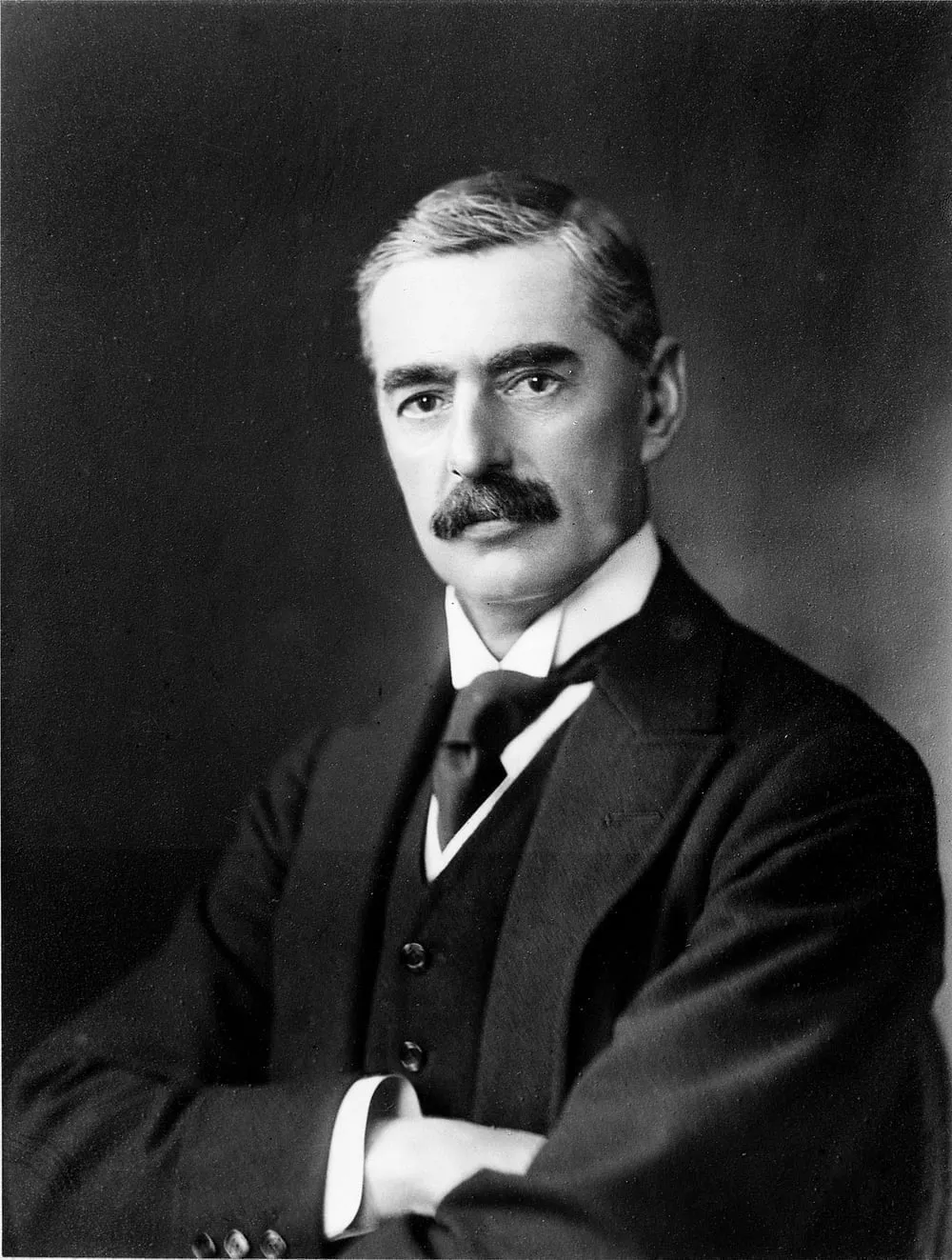
In 1938, many lauded Chamberlain for keeping Britain out of war. After World War II, critics vilified him for appeasement.
-
02
British Conservative Prime Minister from 28 May 1937 to 10 May 1940.
-
03
Historians view the Munich Agreement as a failure because it did not stop German aggression. After the German invasion of Czechoslovakia in March 1939, Chamberlain realized the policy’s failure. He offered a military alliance to Poland on 25 August 1939, a decision that led to World War II.
-
04
His brother started the urban myth that the Chinese have a saying: May you live in interesting times.
-
05
He attempted to form an anti-fascist alliance with the Soviet Union in August 1939. Poland and Romania refused to allow the Red Army on their territory, making the alliance impossible.
-
06
His support for Churchill helped his successor survive the War Cabinet Crisis in late May 1940.
-
07
Even after warnings about the Molotov-Ribbentrop Pact, he refused to dishonor the Anglo-Polish military alliance. On 2 September 1939, he considered accepting Mussolini’s offer of an international summit like the Munich Conference.
-
08
He was dismayed when Poland invaded Czechoslovakia on 1 October 1938 and annexed Zaolzie.
-
09
Some later historians have taken a more favorable perspective of Chamberlain and his policies, citing government papers released under the Thirty Year Rule.
-
10
In early 1940 Chamberlain approved a naval campaign designed to seize the northern part of Norway, including the key port of Narvik, and possibly also the iron mines at Gällivare in northern Sweden.
-
11
Many of the tanks Germany used to invade Poland in 1939 and France in 1940 were made in Czechoslovakia.
-
12
Since 1934, British policy aimed to avoid war with Germany, because officials believed Italy and Japan might join the conflict.
-
13
Revisionist historians have argued it was a mistake for Chamberlain to form a military pact with Poland in 1939 as it could not be enforced.
-
14
In 1938, military and political advisors told Chamberlain that war would be disastrous because Britain was too unprepared.
-
15
Chamberlain angrily denounced the German invasion of Poland in the House of Commons on 1 September 1939, to cheers from MPs.
-
16
The term appeasement generates controversy today, given that the UK and France occupied half the world by force in the 1930s.
-
17
He was a cousin of Alan Napier, half-brother of Sir Austen Chamberlain, and younger son of Joseph Chamberlain.
-
18
A Conservative Lord Mayor of Birmingham who entered Parliament in middle age.
-
19
Terrence Hardiman portrayed him in the original production of the play Never So Good by Howard Brenton, which premiered at the National Theatre in March 2008.
-
20
He spent his time after the Munich Agreement building up the military for war.
-
21
Even Winston Churchill, who completely disagreed with his decision, believed that Chamberlain was a good and intelligent leader.
-
22
He passed the Factories Act which improved working conditions and decreased child labor.
-
23
His approval rating increased to 68% after he made the deal with Hitler.
-
24
He authorised the bombing of German warships at Wilhelmshaven on 3 and 4 September 1939.
-
25
He returned the Treaty ports to Ireland in 1938, causing difficulties for the Royal Navy during the Battle of the Atlantic.
-
26
His military alliance with Poland ensured the Soviet invasion of the country in September 1939.
-
27
He was against going to war with Germany in 1938 as he knew another major war would destroy the British Empire.
-
28
He ordered the laying of mines in neutral Norwegian waters in April 1940.
-
29
Conspiracy theories persist on the far left that Chamberlain wanted Germany to invade the Soviet Union.
-
30
Following the German invasion of Poland, Chamberlain delayed committing to war until the French had also committed.
-
31
Historian Richard Toye said that, until May 1940, Chamberlain was widely seen as a successful and popular prime minister.
-
32
He recognized early that going to war with Germany or Italy would mean the United States supplanting the British Empire as a world power.
-
33
When doctors discovered he was terminally ill with liver cancer, Churchill offered him a life peerage, knighthood, and Companion of Honour. Chamberlain declined.
-
34
Although he stood down as Prime Minister in May 1940, he remained leader of the Conservative Party and served as Lord Privy Seal with the understanding he would resume as PM after the war, but he died in November 1940.