Early life
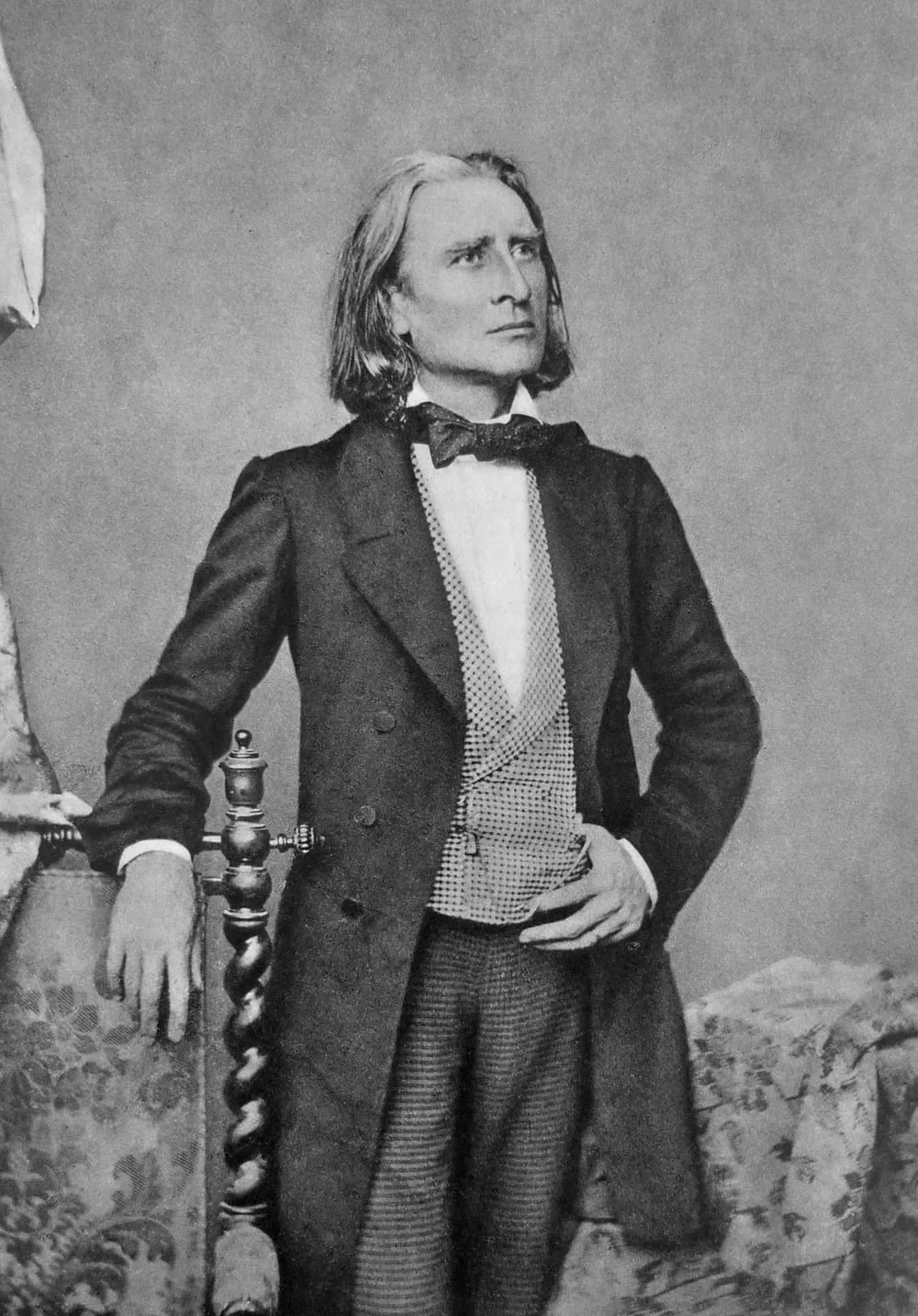
Franz Liszt was born October 22, 1811 in Doborján to Anna Liszt and Adam Liszt. His father, a steward for the Esterhazy court, gave him piano lessons at age six. In Vienna he studied under Carl Czerny and Antonio Salieri.
Franz Ritter von Liszt
7 min read
Reading time
1,208
Words
Published
6
Awards
Piano virtuoso Franz Liszt, born in 1811, began his career at age 12 in Paris. His diabolical stage presence and Mephisto Waltz made him a concert star. His piano transcriptions of Beethoven symphonies and Wagner operas are still played.
Names, aliases, and relatives of Franz Liszt — birth name, kin, and personal ties.
Franz Liszt by the numbers — life, work, and family.
Franz Liszt — early life, career, personal life, and legacy.
Franz Liszt was born October 22, 1811 in Doborján to Anna Liszt and Adam Liszt. His father, a steward for the Esterhazy court, gave him piano lessons at age six. In Vienna he studied under Carl Czerny and Antonio Salieri.
In 1823, at age 12, Liszt moved with his parents to Paris, beginning his career as a traveling virtuoso. In Paris he befriended Frédéric Chopin; they later became rivals. His compositions, including the Mephisto Waltz and Hungarian Rhapsodies, pushed the boundaries of piano technique. Liszt also made piano transcriptions of symphonies by Beethoven, Berlioz, and Wagner.
Liszt lived with Countess Marie D’Agoult for 12 years, fathering three children, including Cosima Wagner, who later married Richard Wagner. After 1847, he had a relationship with Princess Carolyne Wittgenstein. The church forbade their marriage, and under her influence he took holy orders in 1865 and composed religious music.
Liszt’s influence on piano technique and composition included pioneering the symphonic poem. He influenced composers like Richard Wagner, who became his son-in-law. The Mephisto Waltz and his piano transcriptions remain concert staples. He died in Bayreuth in 1886, remembered as the archetypal virtuoso.
Every award, honor, and recognition received by Franz Liszt — Grammys, hall-of-fame inductions, civic honors, lifetime achievements.
A wall of memorable lines from Franz Liszt — lyrics, interviews, and off-the-cuff remarks captured over a lifetime.
To Love Be a Man and Love a Man Is Not Evil. God Wants You to Love All!
Little-known facts about Franz Liszt — origins, oddities, and behind-the-scenes details from a public life.
Liszt eloped to Switzerland with Countess Marie d’Agoult; their relationship ended in 1844. They had three children: Blandine 1835, Cosima 1837, and Daniel 1839. Daniel died in 1859 at age 21, prompting Liszt’s compositions Two Episodes from Lenau’s Faust and Les Morts. Blandine died in childbirth in 1862. Cosima later left her husband for Richard Wagner, bearing his children Isolde, Eva, and Siegfried before marrying in 1870.
Franz Liszt is mentioned in the cartoon Rhapsody Rabbit from 1946.
He was the father of Cosima Wagner.
Liszt is the great-great-grandfather of Eva Wagner-Pasquier, Nike Wagner, and Katharina Wagner.
He became the father-in-law of Richard Wagner when Cosima married him.
He was the grandfather of Siegfried Wagner.
He is the great-grandfather of Wieland Wagner, Wolfgang Wagner, Friedelind Wagner, and Verena Lafferentz.
Liszt’s enormous hands could stretch a 12th interval on the piano.
Quick answers to the questions readers ask most about Franz Liszt.
Celebrities similar to Franz Liszt — same craft, ranked by reach.

🇩🇪 Germany
🇺🇦 Ukraine
🇪🇸 Spain
🇩🇪 Germany
🇫🇷 France

🇯🇵 Japan
🇺🇸 United States
🇺🇸 United States
🇺🇸 United States
🇺🇸 United States
🇺🇸 United States
🇩🇪 Germany