-
01
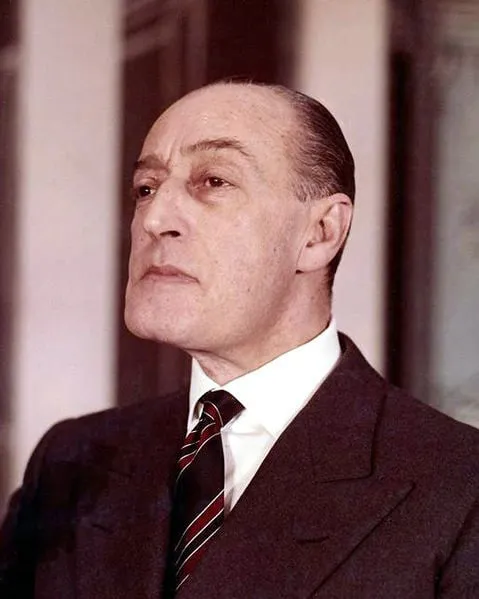
In 1933, Marquis Francesco Gagliardi Foccas adopted Totò. Then in 1946, the Court of Naples granted him an extensive list of titles including Imperial Highness and Prince Don Antonio.
-
02
Totò’s only son, Massenzio, born with Franca Faldini, died at birth.
-
03
Liliana De Curtis was his daughter.
-
04
During the 1940s, Totò had a relationship with actress Silvana Pampanini.
-
05
Apart from acting, Totò was a poet and songwriter; his most famous Neapolitan song Malafemmena was a declaration of love and hate to his first wife.
-
06
Totò considered the film Cops and Robbers 1951 his best work.
-
07
After suffering a double retina detachment that left him nearly blind, Totò relied heavily on his stunt double Dino Valdi, who performed most moving scenes in later films like The Hawks and the Sparrows 1966. Upon his death, Totò bequeathed Valdi a full set of stage costumes and the heritage of his character.
-
08
From 1952 until his death, Totò was the partner of actress Franca Faldini.
-
09
In the 1950s, Totò began composing poetry; his best-known poem A Livella depicts a rich man and a poor man meeting after death to discuss their differences.
-
10
Totò mastered the guitti tradition, the Neapolitan scriptless comedians of Commedia dell’Arte, and developed his trademark style: puppet-like gesticulation, emphasized facial expressions, and surreal humor focused on primitive urges like hunger and sexual desire.
-
11
As a songwriter, Totò created Malafemmena Wayward Woman, dedicated to his wife Diana after their separation, now a classic of Neapolitan music.
-
12
Totò had a playboy reputation and a relationship with singer and dancer Liliana Castagnola, who committed suicide after their breakup—a tragedy that deeply affected him.
-
13
Totò was multitalented: an actor, comedian, screenwriter, dramatist, poet, singer, and lyricist.
-
14
Though his mother wanted him to be a priest, Totò was acting as a comedian by age 15 in 1913, using the stage name Clerment.
-
15
Totò died at 69 on April 15, 1967 in Rome after a series of heart attacks. His popularity was so immense that three funeral services were held: one in Rome, one in Naples, and a third in the Rione Sanità quarter where an empty casket was paraded by a local Camorra boss.