-
01
The name Seuss, his mother’s maiden name, is pronounced to rhyme with voice, not with loose as it commonly is.
-
02
His first children’s book, And to Think That I Saw It on Mulberry Street 1937, was rejected by over 20 publishers before being accepted.
-
03
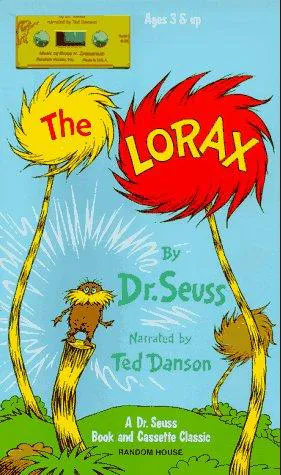
Of his many works, only four are political: The Lorax parodied environmental exploitation, The Butter Battle Book commented on the arms race, The Sneetches dealt with racism, and Yertle the Turtle represented Adolf Hitler and the Third Reich.
-
04
Despite the famous line from Horton Hears a Who! — A person’s a person no matter how small — being used by anti-abortion groups, Seuss himself supported reproductive rights, and his widow threatened lawsuits against such use.
-
05
One night on a train, Seuss saw a pompous man with a hat and imagined that if the hat were knocked off, another would appear, inspiring The 500 Hats of Bartholomew Cubbins.
-
06
The film adaptation of The Lorax 2012 was released on what would have been his 108th birthday.
-
07
He was a recluse, spending much of his time alone in his studio.
-
08
Before his children’s books, he made sculptures of fantastic animals as taxidermist-mounted heads, whose surreal details later appeared in his illustrations.
-
09
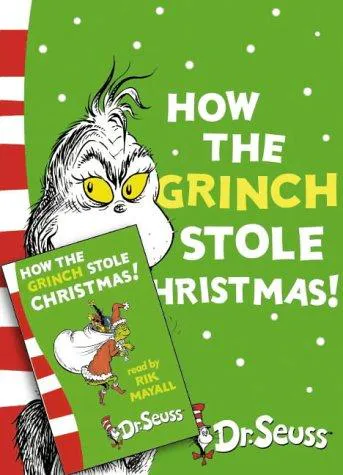
He partially based the Grinch on himself: from his hilltop house in California, he looked down in disgust at Christmas decorations in the valley.
-
10
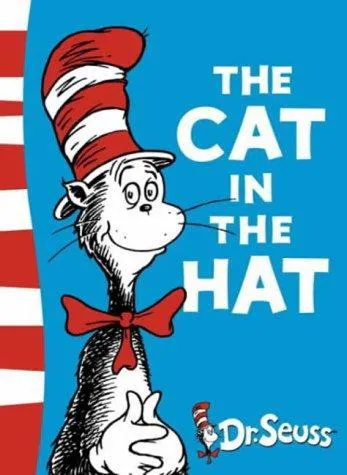
In the late 1980s, he wanted The Cat in the Hat made into a movie with Robin Williams, Steve Martin, John Candy, or Eddie Murphy as the Cat; the 2003 film cast none of them.
-
11
He attended and graduated from Dartmouth College, Hanover, NH, class of 1925.
-
12
An unpublished 1973 manuscript for My Many-Colored Days had no illustrations; he hoped a great color artist would illustrate it, and it was published in 1999 with art by Steve Johnson and Lou Fancher.
-
13
Two of his works have been translated into Latin: The Cat in the Hat as Cattus Petasatus and How the Grinch Stole Christmas as Quomodo Invidiosulus Nomine Grinchus Christi Natalem Abrogaverit.
-
14
The University of California-San Diego renamed its main library the Geisel Library in 1995, honoring him and his wife Audrey; it holds an 8,500-item collection of his works.
-
15
He worked as a commercial artist, drawing humorous spot drawings for Standard Oil products, including Flit bug spray.
-
16
His Cat in the Hat appears on a USA 33-cent commemorative stamp in the Celebrate the Century Series, issued May 26, 1999.
-
17
As a schoolboy during World War I, classmates nicknamed him The Kaiser due to his German ancestry.
-
18
He attended and graduated from Springfield Central High School in Springfield, MA, class of 1921.
-
19
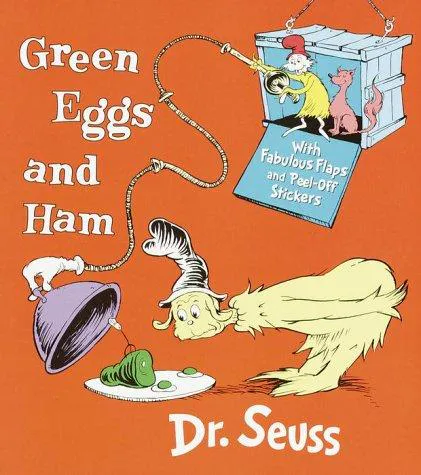
He supposedly wrote Green Eggs and Ham on a bet with publisher Bennett Cerf to use only 50 words; published in 1957, Cat in the Hat became his biggest seller, leading to the Beginner Books series.
-
20
He is pictured on a USA 37-cent commemorative stamp issued March 2, 2004, the 100th anniversary of his birth, depicting six characters: the Cat in the Hat, the Grinch, the Glotz, the Skritz, the unnamed young fellow, and the Skrink.
-
21
He was a member of Sigma Phi Epsilon national fraternity New Hampshire Alpha chapter at Dartmouth College.
-
22
He wrote and drew political cartoons in the 1940s.
-
23
He was a chain smoker and casual drinker.
-
24
In 1942, Col. Frank Capra placed him in charge of the Animation Division of the Armed Forces Motion Picture unit, producing instructional cartoons starring Private Snafu, voiced by Mel Blanc, from 1942-45.
-
25
He was a staunch and vocal critic of America First, a movement that opposed U.S. entry into World War II, and penned cartoons expressing this belief.
-
26
Although famous for social messages, he usually did not write with morals in mind, saying, A kid can see a moral coming a mile away.
-
27
During World War II, he joined the U.S. Army, was sent to Hollywood, and wrote for Frank Capra’s Signal Corps Unit, winning the Legion of Merit.
-
28
The music for The Cat in the Hat Song Book, a book of Seuss-penned lyrics for young singers, was written by Eugene Poddany.
-
29
He was a lifelong liberal Democrat and supporter of President Franklin D. Roosevelt and the New Deal.
-
30
In the early 1940s, he was a political cartoonist for PM, a left-wing New York newspaper with no advertising; a book of his cartoons was later published.
-
31
A biography/bibliography appears in Contemporary Authors, New Revision Series, Vol. 132, pp. 162-167 as Theodor Seuss Geisel, 2005.
-
32
He was a member of the Sigma Phi Epsilon fraternity.
-
33
His first nationally published cartoon appeared on July 16, 1927, in The Saturday Evening Post; by October 1927, he was a regular writer and illustrator for the humor magazine Judge.
-
34
He was married twice but never had children of his own.
-
35
Starting in 1965, he used the pen name Theo LeSieg for books he wrote but did not illustrate; LeSieg is Geisel spelled backward.
-
36
While not a communist, he thought the House Committee on Un-American Activities and its purges were a greater threat than the Soviets.
-
37
Despite claiming no intended morals, his books often had political meanings, covering environmentalism, anti-consumerism, racial equality, the arms race, anti-authoritarianism, and anti-isolationism.
-
38
He lectured at a 1949 writers conference at the University of Utah, explaining that writers must consider logical implications of a story premise, using the example of a man with two heads.
-
39
When writing poetry, he typically used anapestic tetrameter, a poetic meter with four anapestic feet per line.
-
40
He was born to a family of brewers, but the brewery shut down during Prohibition 1920-1933.
-
41
He wrote Marvin K. Mooney Will You Please Go Now! 1972, and in 1974 published a variation called Richard M. Nixon Will You Please Go Now!, calling for Nixon’s resignation during Watergate.
-
42
His book I Had Trouble in Getting to Solla Sollew 1965 is a satirical take on fantasy quests and utopian paradises, concluding that it is safer to face troubles at home.
-
43
His first published book, Boners 1931, a collection of children’s sayings he illustrated, topped The New York Times non-fiction bestseller list.