-
01
Lang claimed that on 25 March 1933, two days after The Testament of Dr. Mabuse 1933 had been banned, he was summoned to the Nazi Ministry of Propaganda to meet Joseph Goebbels. Goebbels explained the ban and offered Lang the position of production supervisor at UFA, shocking Lang. Lang said he needed time to think, then fled to Paris that night, selling his wife’s jewelry. The story may be exaggerated as there is evidence he left weeks later.
-
02
His earlier work influenced directors including Alfred Hitchcock, Luis Buñuel, and Orson Welles.
-
03
His first wife, Lisa Rosenthal, committed suicide by shooting herself in the chest. It was rumoured she did this after finding Lang in a compromising situation with Thea von Harbou.
-
04
Lang dubbed Peter Lorre’s off-key whistling in M 1931 because he felt it suited the character.
-
05
He claims to have invented the countdown for dramatic purposes in Woman in the Moon 1929. His use of countdown is the first ever recorded and inspired real-life rocket launch sequences.
-
06
Dorothy Parker once remarked that Lang got where he was by the sweat of his Frau, referring to his wife’s campaigning for his career.
-
07
In both Germany and the United States, he was one of the most disliked directors, which sometimes hurt him in Hollywood because actors would refuse to work with him.
-
08
As a soldier in the Austro-Hungarian army during World War I, he fought in Russia, Romania, and Italy, was wounded three times, and was commissioned as a lieutenant from an initial enlistment as a private.
-
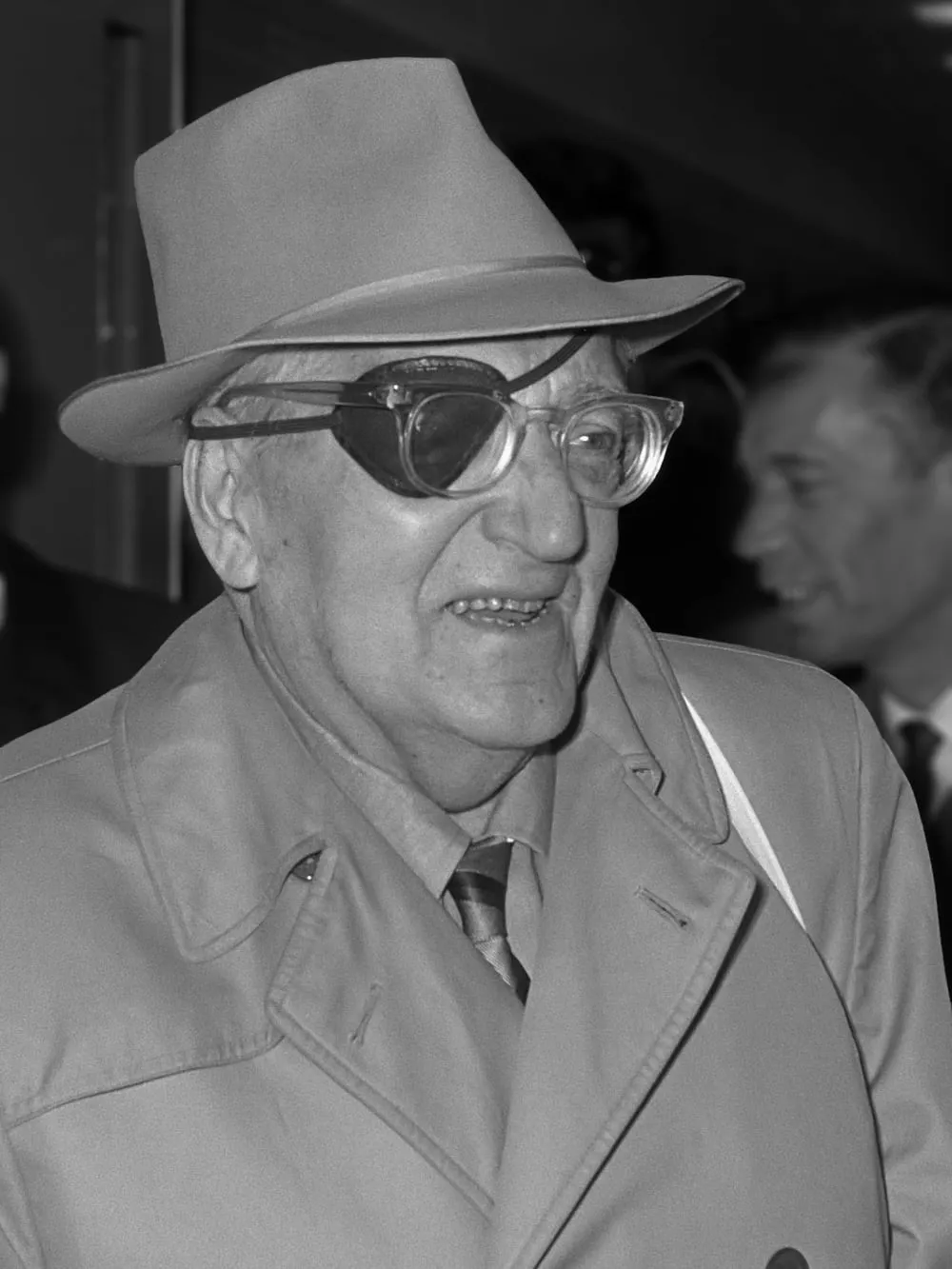
09
His second wife, Thea von Harbou, divorced him after finding evidence of his intimate relationship with Lily Latte. Lily was also married but divorced, and lived with Lang as his personal assistant from 1931 until they married in 1971.
-
10
Lang learned to speak French and English as an adult in addition to his native German.
-
11
After a journey to America, Lang returned to Germany to make Metropolis 1927, on which he acquired a reputation for being a tyrant on set, leading many Hollywood actors to later refuse to work with him.
-
12
When he decided to leave Germany in 1933, his wife Thea von Harbou divorced him and remained in Germany to make propaganda films for the Nazi regime.
-
13
He was voted the 30th Greatest Director of all time by Entertainment Weekly.
-
14
Unlike many silent-era directors, he welcomed sound but didn’t rush into it, making his first sound film in 1931, M, a dark tale about a pedophile which was a commercial success and made Peter Lorre a star.
-
15
An extensive interview with Peter Bogdanovich resulted in the book Fritz Lang in America, published by Praesger in 1967.
-
16
In 1918 he met producer Erich Pommer in Berlin, who hired him as an actor and scriptwriter.
-
17
He directed two films selected for the National Film Registry: Fury 1936 and The Big Heat 1953.
-
18
He served as president of the Official Competition jury at the 17th Cannes International Film Festival in 1964.
-
19
An animated version of Lang appeared in the Japanese film Fullmetal Alchemist the Movie: Conqueror of Shamballa 2005, voiced by Hidekatsu Shibata.
-
20
Before his death in 1976, he planned a film about hippie culture.
-
21
Lang was drafted into the Austro-Hungarian army during WWI in 1915. As a lieutenant in Italy he was wounded in the shoulder and decorated.
-
22
After leaving Germany he made several films in France, then went to England and finally the US, where he helped found the Anti-Nazi League.
-
23
Lang made only a few films in the 1920s compared to other German directors, but those are now classics of film history.
-
24
He collected primitive art.
-
25
He was nearly blind at the time of his death.
-
26
He is interred at Forest Lawn Hollywood Hills, Los Angeles, in the Enduring Faith section.
-
27
He was the second son of Anton Lang, an architect, and Pauline Schlesinger.
-
28
After the outbreak of World War I he volunteered for the Austro-Hungarian army and was sent to Russia, Romania, and Italy, where he was wounded several times and awarded medals. During his time in the military hospital he wrote his first scripts, one of which was likely adapted for a Stuart-Webbs serial.
-
29
In 1933 Goebbels offered him the leadership of the German movie business. Lang said he would think it over, then went directly to the train station and hopped a train to Paris.
-
30
Before World War I, he was interested in art and spent 1913 and 1914 as an artist in Paris.
-
31
He was a private man, refusing to discuss himself in interviews.
-
32
He was interviewed by fellow director Peter Bogdanovich in 1967.
-
33
Peter Lorre never forgave Lang for his treatment on the set of M, especially for having him thrown down some steps 12 times before Lang was satisfied with the take.